07
Zen mode
Hide sidebars and keep attention on the text.
When the outline tree or utility panes distract you, Zen mode simplifies the editor chrome. Enter and exit quickly from the shortcut.
Desktop novel writing app
Built from scratch in 2026 to support professional writing—a macOS and Windows app.
Download01
Apply literary marks directly on the manuscript in the editor.
Ruby, emphasis dots, sidelines, warichu, gaiji, kaeriten, enclosure, and more are available from the toolbar—edit and preview in the same place.
On export, choose a ruby notation for your target platform. Nineteen styles are supported; see the reference tables at the bottom of this page.
02
Arrange chapters, sections, and scenes freely—including nesting—so long manuscripts stay navigable.
Build hierarchy with outline nodes and place manuscript pages underneath. Reorder and nesting depth follow how your story is structured.
Each manuscript page can carry a writing note and TODOs with optional due dates. Progress and overdue items appear in the outline view.
03
Split different kinds of writing inside one project into separate binders.
Besides the main text, keep drafts, research, side stories, diaries, and other purposes in their own binders. Focus on the binder you open; the rest stay out of the way.
Inside each binder you can nest files. Organize research and alternate drafts with the same hierarchical controls as the main outline.
04
Place videos and images inside the manuscript.
Insert assets from the project, local disk, or the web. Useful when writing scripts or scenes alongside storyboards or reference footage.
Use it when you want visual references in the same flow as the prose—not only plain text.
05
Save output format and timing as named plans.
Each manuscript node can carry one of these plan states. Export plans choose which states to include.
Example uses
Format, ruby style, encoding, line endings, and run timing stay in the plan so each export matches.
06
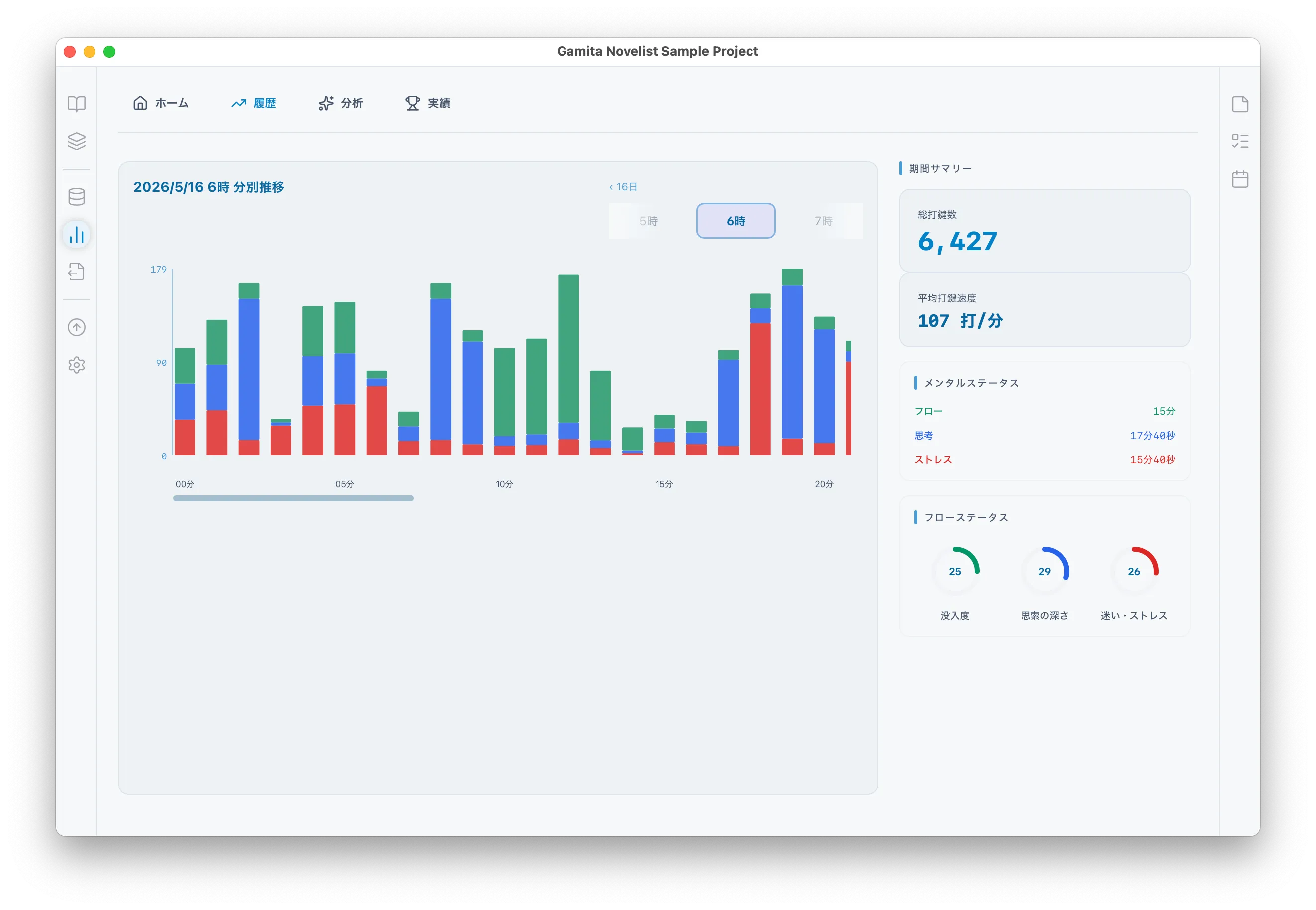
Turn keystroke traces into a view of your writing record and growth. This is a core capability of Gamita Novelist.
See when and how much you wrote—stretches of focus, time spent thinking, higher-stress intervals. Review keystroke timelines second by second and keep your writing style as data.
Beyond flow, thinking, and stress breakdowns, the feature is meant for achievement and growth: compare with your past self and track changes in habit and pace.
Estimation uses a proprietary keystroke-dynamics algorithm. Design and evaluation are published as a white paper; the product builds on that work. Data stays on your device and is not sent to servers without consent.
The blog also covers research background for state estimation in a novel-writing app. See the article and PDF for details.
07
Hide sidebars and keep attention on the text.
When the outline tree or utility panes distract you, Zen mode simplifies the editor chrome. Enter and exit quickly from the shortcut.
08
Scroll assistance keeps the cursor line at a fixed place on screen.
Reduces the sense of the page sliding away as you type, so attention stays on the line you are writing—support for long sessions.
These marks are available for Japanese literary typography.
| Mark | Description |
|---|---|
| Ruby | Attach readings to base characters. |
| Emphasis dots (bōten) | Place emphasis dots beside characters to stress a phrase. |
| Sideline (bōsen) | Draw a sideline along text to guide the eye. |
| Warichu | Insert a compact two-line note inside the body text. |
| Gaiji | Handle characters outside the usual font repertoire. |
| Kaeriten | Insert kaeriten such as re-ten used in kundoku readings. |
| Enclosure (kakomi) | Box characters or phrases to set them apart visually. |
Ruby notations available when converting. Nineteen styles cover major platforms, Aozora, HTML/EPUB, and stripping ruby.
| Use / platform | Format |
|---|---|
| Aozora Bunko | |base《ruby》 |
| Shōsetsuka ni Narō | base(ruby)(full-width parens) |
| Shōsetsuka ni Narō | base(ruby)(half-width parens) |
| Shōsetsuka ni Narō | |base(ruby)(bar + full-width) |
| Shōsetsuka ni Narō | |base(ruby)(bar + half-width) |
| Kakuyomu | base《ruby》(short form) |
| Alphapolis | #base__ruby__# |
| Alphapolis | |base《ruby》(Aozora-compatible) |
| pixiv | [[rb:base > ruby]](legacy) |
| pixiv | [ruby:base/ruby](new) |
| Every Star | base[ruby](full-width) |
| Every Star | base[ruby](half-width) |
| Every Star | |base[ruby](bar + full-width) |
| Every Star | |base[ruby](bar + half-width) |
| Hameln | [r:base/ruby] |
| Mahou no i-land | ((base/ruby)) |
| HTML5 | <ruby> tag |
| EPUB3 / Kindle | EPUB3 / Kindle format |
| Strip ruby | Base characters only |
File formats handled by Convert, and their document export support. “EPUB3 / Kindle” in the ruby table above is a ruby notation; EPUB3 here means document-file export.
| Format | Status |
|---|---|
| Plain text | Supported |
| EPUB3 | Planned |
| Word (docx) | Planned |
Installers are available for macOS and Windows.